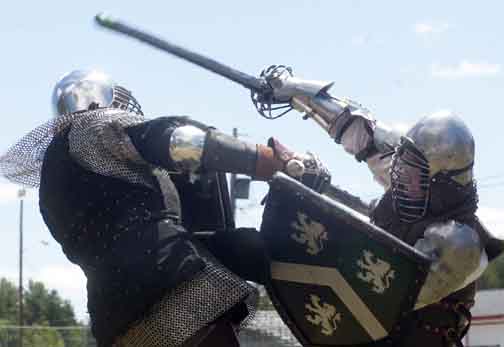
“My dear colleague, you have come to our beautiful city just in time for the medieval festival[1]. You couldn’t have had better timing[2]. Everybody is taking part in[3] the festivities, even our patients, of course, you will see.”
As he spoke[4], Baptiste Rouque-Jaune, his elbow on the table and a hand lying on his belly, kept flattening his tie. It was a habit of his, usually a sign that he had had too much to drink and that he was feeling satisfied[5] with himself.
Frédéric Soumagne was the newcomer at the Grand Bercail. He was replacing Emile Borsat, who was killed two months earlier in an earthquake in Japan.
“He had longed[6] to see Japan for thirty years. In the end, it became[7] an obsession. As far as we know, he was killed an hour after having set foot on Japanese soil. He hadn’t even left the airport. He was waiting for his baggage.”
“What bad luck[8],” Frédéric Soumagne commented soberly, glancing over his bifocals.
“The most incredible[9] thing in this story is that the earthquake only claimed one victim, my eminent colleague Emile Borsat. What do you think of that, hunh?”[10]
“What really bad luck,” Soumagne thought appropriate to reaffirm.
[1] Celebrations. NOT « feast » because this is a big meal, one that is usually associated with a religious holiday.
[4] Here there is an editorial decision to make. Should you use the present tense? Should you use the narrative past? The latter is the general tense used by the narrator in story telling and is quite common in English, whereas the present for narration is less common and generally used for dramatic effect only. However, if you choose to use the present tense here, to mirror the present in the French text, you must be coherent throughout the rest of the text.
[5] Pleased with himself, self-satisfied. A feeling of self-satisfaction.
Part Two: Get ready for the midterm. Vocab. Past tense. Vocab.
Homework: There is none in particular. Whew. You'll have a slight break during the week of your holidays. We will do the correction of the midterm in class during the week following your vacation. I can, if you wish, post the next text sooner than that. Send me an email to let me know what you prefer.
Greetings again this week. I don't have much to add this week except that I am pleased with how the classes are going. You are participating well and your suggestions and questions are pertinent. Thank you. Keep up the good work.
***BRING YOUR PHOTOS for the Trombinoscope!!! ***
Correction: Moira
They stood there for a moment without moving[1], a few steps[2] from each other, and Mrs Dare pretended to be reading the letter that he had just given her, though she had already understood its contents several seconds ago and was now, from the corner of her eye, observing the newcomer. Without knowing quite why, she felt somewhat embarrassed looking at him. “At any rate,” she said to reassure herself, “he certainly looks respectable.”
She saw him from the side, his face struck by the rays of the sun which poured[3] into the room between the leaves of the trees, and despite herself, she found him quite handsome, even if he were red-headed[4]. That’s what troubled her[5], this flaming head of hair, the milky whiteness of his skin. She had to gain control over herself so that he wouldn’t see the slight repulsion that she felt for him[6]. She didn’t notice right away[7] that he had dark eyes. Tall and a bit slender in his dark clothes that didn’t seem to suit him[8], he had his arms crossed[9] over his chest and was looking at the street defiantly. At his feet, a yellow bag, its leather cracked open in spots, was stuffed to the point of being a sphere. After an instant, he changed his demeanour and reached his big hand towards the opening of the bag which he silently opened up a few centimetres. Then, standing upright, he stuffed[10] his fingers into the pockets of his vest, his eyes on the horizon[11].
Maybe he knew he was being watched. He let a minute or two go by, then, risked a quick, sideways glace towards Mrs. Dare who was still reading. Finally, as if authorized by this long wait, he looked more intensely around himself.
The room had a low ceiling and the walls were covered with a faded, yellowing paint. Near the window, there were two rocking chairs facing each other, separated by a small braided rug with fading blue and purple wool. A round painted wood table held a large plant with vigorous and shiny leaves which was the central decorative piece in the little study[12]. There was an upright piano in the corner and on its music stand rested a songbook of popular music whose bold printed titles rang out like a vulgar laugh. The young man turned his head. “It’s the university,” he thought. “At the university, things are like that.” But at his home, in his parents’ home, the piano was only ever used on Sundays, when church songs were sung. The rest of the week it was covered with a long olive covered sheet that protected the keys.
Ever more time passed, but nothing led him believe that Mrs. Dare had finished reading because, immobile, she still held the paper in her thin fingers and didn’t move. “I can’t send him away just because he is red headed,” she said to herself. She looked at his dusty shoes and supposed that he must have come on foot from the station, out of frugality. Again she asked herself, “I wonder if he smells. Red heads sometimes smell strong[13]. I couldn’t bear that. I have to admit, though, that from here I don’t smell anything.”
Suddenly, she folded the letter and put it back in its envelope.
Franz Bartelt, Le grand bercail (2002) (202 mots) This was a former exam...
« Cher collègue, vous arrivez dans notre belle ville juste au moment où commencent les fêtes médiévales. Vous ne pouviez pas mieux tomber. Tous les habitants participent à la fête. Nos malades aussi, évidemment. Vous verrez. »
Tout en parlant, Baptiste Rouque-Jaune, un coude sur la table, une main sur le ventre, lisse sa cravate. C’est un tic, habituellement le signe qu’il a trop bu et qu’il se sent content de lui. Frédéric Soumagne est nouveau venu au Grand Bercail. Il remplace Emile Borsat, tué deux mois plus tôt dans un tremblement de terre, au Japon.
« Il avait envie de connaître le Japon depuis trente ans. A la fin, c’était devenu une obsession. D’après ce qu’on sait, il est mort une heure après avoir posé le pied en terre nippone. Il n’était pas encore sorti de l’aéroport. Il attendait ses bagages.
-- Pas de chance, commente sobrement Frédéric Soumagne, en jetant un coup d’œil par-dessus ses lunettes à double foyer.
-- Le plus extraordinaire dans cette histoire, c’est que ce tremblement de terre n’a fait qu’une seule victime : Emile Borsat, mon éminent confrère. Qu’est-ce que vous en dites, hein ?
-- Vraiment pas de chance, croit juste de confirmer Soumagne.
Running commentary... In this week's class, we began the real work of hashing through texts on the board. It is a long process, and as you noticed, we only slogged through about half of the Druon text. But, it is important to get your suggestions and for you to ask questions about your translations.
Here is the list of animal names (males, females, babies and groups): www2.biology.ualberta.ca/uamz.hp/MamName.html (however, I admit that I must have read it wrong and a female rat is rather called a Doe and not a Queen... I guess that was a kind of Freudian slip)
Also, in Group 1, the Moroccan author and book that I mentioned was Mohammed CHOUKRI, al-khubz al-hâfî(censored until 2000), with Le Pain Nu (translated in French 1980 by Tahar Ben Jalloun - who, in fact, was also a friend of his) and For Bread Alone (translated by Paul Bowles in 1973)
CORRECTION of Maurice Druon:
In the beginning of Spring 1929 (In the early spring of 1929), a person[1] arrived in Paris who was seldom spoken of in the papers, who didn’t attend salons (who was never seen in the fashionable circles), and yet whose presence weighed (bore) down upon the city[2]. He had rented half a floor at the Ritz, on the Vendôme side and telephone line had been reserved[3] for his personal use alone. An hour never went by (elapsed) without a messenger boy (page) bringing him up a platter heavy with letters and telegrams. But, the maids[4] who cleaned his apartments (his suite) never found any paper, even at the bottom of the waste (dust) bins. There were no women[5] in his life, except for (unless you consider his) a secretary with the grey and boyish hair (a bob haircut), who had a tortured, intelligent and ferocious appearance/exterior appearance[6]. Men of various looks and ages, who sometimes looked like body guards and at other times looked like head sales-clerks (department managers/supervisors) in department stores, came and went. And, in front of the hotel, a car with thick (tinted) windows was waited for him[7].
This person, who could cause the ruin of hundreds of industrial companies and the misery of hundreds of thousands of workers, who could refuse the invitations of kings, provoke (stir up, rile up) south American[8] revolutions and topple (bring to the ground) European ministries, who owned a fortress on an island in the Baltic and the biggest yacht in the world, (which was) anchored in Trieste, who travelled with four passports, even one from the Vatican, and who was decorated by every order imaginable, was sixty years old and called/named[9] Karl Strinberg.
[1]A man, someone, NOT “Character” because a character is more of a “strange or unusual person”, not someone as non-descript as we want to present here.
[2]Here, City is better than Town because a city is more cosmopolitan.
[3]NOT Blocked, because blocked means obstructed. This is a contre sens.
[4]You can use Domestic staff, but this would be more modern and politically correct. Maids, corresponds closer to the era of the story.
[5]NOT wife, because the meaning is about ANY women, and placed in opposition to the boyish secretary.
[6]Who constantly had a tortured, intelligent and ferocious expression on her face. NOT mask, this is just wrong. NOT face because this only talks about the physical outside.
[7] … a car was parked waiting for him permanently. // a car was waiting at his beck and call.
Depuis un moment, ils se tenaient immobiles, debout, à quelques pas l'un de l'autre, et Mrs. Dare feignait de lire la lettre qu'il venait de lui tendre, mais il y avait plusieurs secondes déjà qu'elle avait pris connaissance de ce document et maintenant, du coin de l’œil, elle observait le nouveau venu. Sans bien savoir pourquoi, elle éprouvait un sentiment de gêne à le regarder en face. « En tout cas, se dit-elle pour se rassurer, il a certainement l'air honnête. »
Elle le voyait de profil, le visage frappé par les rayons de soleil qui se glissaient dans la pièce entre les feuilles des arbres, et malgré elle il lui parut beau, bien qu'il fût roux. C'était cela qui la troublait, cette chevelure de flamme, ce teint d'une blancheur laiteuse, et elle se domina pour qu'il ne comprît pas l'espèce de répulsion qu'il lui inspirait. Elle ne remarqua pas tout de suite qu’il avait les yeux noirs. Grand et le corps un peu mince dans ses vêtements sombres qui ne paraissaient pas faits pour lui, il croisait les bras sur la poitrine et regardait la rue d'un air de défi. A ses pieds, un sac jaune dont le cuir se fendillait par endroits était bourré au point de ressembler à une sphère. Au bout d'un instant, il changea d'attitude, allongea une grande main vers l’ouverture du sacqu'il délaça sans bruit de quelques centimètres, puis, se redressant, enfonça le bout des doigts dans les poches de son veston, les yeux au loin.
Peut-être se savait-il observé. Il laissa passer une minute ou deux puis risqua un coup d’œil oblique vers Mrs. Dare qui lisait toujours. Enfin, comme si cette longue attente l'y autorisait, il jeta plus hardiment la vue autour de lui.
La pièce était basse de plafond et les murs recouverts d'une tenture décolorée qui tirait sur le jaune. Près de la fenêtre, deux fauteuils à bascule se faisaient face, séparés par un petit tapis au point de chaînette dont les laines bleues et mauves se fanaient. Une table ronde en bois peint supportait une grosse plante aux feuilles vigoureuses et lustrées qui formait l'ornement central de ce petit salon. On voyait dans un coin un piano droit étalant sur son porte-musique un album de chansons en vogue dont les titres en lettres grasses faisaient l'effet d'un rire vulgaire. Le jeune homme détourna la tête. « C'est l'Université, pensa-t-il. A l'Université, c'est comme ça. » Mais chez lui, dans la maison de ses parents, le piano ne servait que le dimanche, lorsqu’on chantait des cantiques, et toute la semaine il gardait sa longue bande de drap olive qui protégeait les touches.
Du temps s'écoula encore, mais rien ne laissait croire que Mrs. Dare eût achevé sa lecture, car elle tenait encore le papier entre ses doigts maigres et ne bougeait pas. « Je ne peux pourtant pas le renvoyer parce qu il est roux », se dit-elle. Elle observa ses chaussures poudreuses et supposa qu'il était venu à pied de la gare, par économie. De nouveau elle s'interrogea : « Je me demande s'il sent. Les roux sentent très fort quelquefois. Ça, je ne le supporterais pas. je dois reconnaître que d'ici, je ne sens rien.
Tout à coup, elle plia la lettre qu'elle remit dans son enveloppe.